Source: Army Technology - The 10 most effective self propelled artillery
Modern self propelled howitzers such as the 2S35 Koalitsiya-SV, Archer, Donar and PzH 2000 offer high lethality and manoeuvrability and are the backbone of the artillery corps.
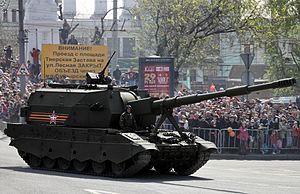
The 2S35 Koalitsiya-SV is a 152mm new-generation self-propelled howitzer (SPH) developed by JSC Central Research Institute Burevestnik (Petrel), a division of Uralvagonzavod based in Nizhny Novgorod. The first batch of the 2S35 Koalitsiya-SV howitzers was delivered to the Russian Armed Forces in 2015. The tracked chassis such as the T-72/90 or T-14 Armata main battle tanks and 8×8 wheeled platforms can be used to integrate the 2S35 Koalitsiya-SV system. The howitzer can fire high-explosive precision-guided munitions, jammer carrying projectiles, anti-tank submunitions, as well as standard and rocket-assisted high explosive-fragmentation (HE-FRAG) projectiles. The rate of fire is eight rounds a minute while the maximum firing range is 70km. The vehicle has a maximum speed of 60km/h and an operational range of 500km.

The Archer 155mm, 52 calibre self-propelled howitzer developed by BAE Systems can strike stationary and mobile targets at land and sea. The capability to meet the present and future requirements of ground troops makes it one of the best howitzers in the world.
The wheeled artillery system features a fully automated 155mm/L52 gun and a remotely controlled weapon station (RCWS) based on a 6×6 Volvo commercial articulated vehicle. The main gun delivers an intensive rate of fire of 21 rounds per 3.5 minutes and can fire all types of 155mm projectiles, including advanced sensor-fused and precision-guided munitions. The Archer system operates in conjugation with current command and control systems and delivers outstanding tracking capability to fire rounds for a maximum range of 50km. Its cabin is designed to protect the crew from artillery fragments and mines, as well as nuclear, biological and chemical (NBC) threats. The system completes the firing sequence and leaves the place of action in just 40 seconds. The highly mobile vehicle provides a maximum speed of 70km/h and a cruising range of 500km.
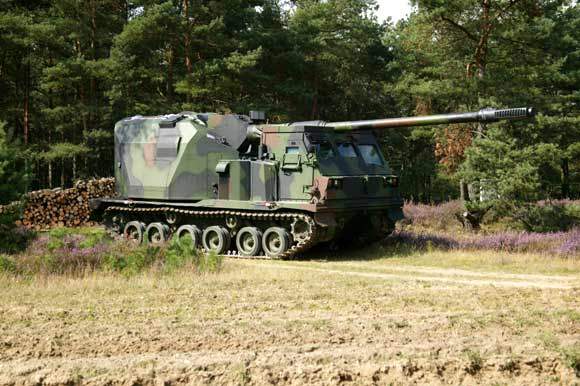
The DONAR artillery gun module from Krauss-Maffei Wegmann (KMW) is a highly advanced 155mm howitzer based on the ASCOD 2 infantry fighting vehicle chassis supplied by General Dynamics European Land Systems (GDELS). The DONAR system takes the traditional artillery doctrine to a new level by incorporating a fully automatic firing module on a highly mobile platform. The 35t system carries a combat load of up to 30 projectiles and 145 charges. It can fire six rounds a minute for a maximum range of more than 40km, which can be increased to over 56km with the use of higher range munitions. The armoured cabin protects the two-man crew against small arms, artillery splinters, mortar munitions and NBC threats.
The module is equipped with hybrid inertial navigation and GPS, automatic fire control system, as well as auto tracking and correction features. The DONAR system can travel at a top speed of over 60km/h for a maximum range of 500km.

The PzH 2000 is a highly mobile 155mm/L52 artillery system developed by KMW for the German Army. The capability to support both conventional and asymmetric missions makes the PzH 2000 one of the most effective howitzers in the world. More than 330 PzH 2000 systems have been delivered to four Nato member countries to date. The howitzer weighs 57t and can carry five crew members, as well as a combat load of 60 projectiles and 288 charges. A fully automatic loading system, navigation system and fire control computer ensure the engagement of targets over the range of 56km at a rate of fire of eight to ten rounds a minute. The PzH 2000 integrates the built-in test equipment (BITE) system and can fire in multiple rounds simultaneous impact (MRSI) mode. The self-propelled artillery system has a maximum range of 420km.

CAESAR is an effective self-propelled artillery system produced by Nexter Systems to deliver direct fire, counter-battery fire and coastal defence in support of motorised, mechanised and armoured units. It is capable of firing all standard Nato 155mm ammunition. The CAESAR artillery system is currently operated by the armies of France, Saudi Arabia, Thailand and Indonesia. The French Army successfully deployed CAESAR howitzers in Afghanistan and Lebanon. The system has a rate of fire of six rounds a minute and can fire extended range full bore (ERFB) ammunition for 42km and rocket shells for a maximum distance of over 50km. The armoured cab of the CAESAR offers level 2 STANAG 4569 protection while a new cab with levels 2a and 2b mine and improvised explosive device (IED) protection is also available. The artillery is mounted on a 6×6 truck chassis and can be airlifted by a C130 aircraft in a single load.

The K9 Thunder is a 155mm self-propelled artillery system developed by Samsung Techwin to meet the requirements of the Republic of Korea Army (ROKA). It is also produced under licence in Turkey as ‘T-155 Firtina’ (Storm). The South Korean Army received its first K9 systems in 1999 and is expected to induct more than 1,000 systems by 2016. The 155mm/52-calibre gun fitted to the K9 offers great firepower by firing projectiles at a rate of six rounds per minute for a maximum range of 41km. The howitzer is complemented by K10 fully automatic ammunition resupply vehicle (ARV). The K9 Thunder is powered by an MTU MT 881 Ka-500 eight-cylinder water-cooled diesel engine, developing 1,000hp. The propulsion system ensures a top speed of 67km/h and an operational range of 480km.

The Nora-B/52 is a new generation 155mm/L52 self-propelled howitzer produced by Yugoimport SDPR to replace the ageing artillery systems in service with the Serbian Army. The open architecture of the system ensures the integration of subsystems according to the requirements of the customers. The Serbian Army received its first 12 NORA-B/52 systems in 2007. The artillery was also delivered to the armed forces of Myanmar, Kenya, and Bangladesh. The howitzer is capable of firing all standard Nato 155mm ammunition at a rate of six rounds per minute. It can strike targets within the range of 42km using extended range full-bore – base bleed (ERFB-BB) projectile. The NORA-B/52 is equipped with an automatic gun loader. The armoured version offers protection against small arms fire, artillery shell splinters and mines. The system, mounted on FAP 8×8 cross-country chassis, attains a maximum speed of 80km/h to 100km/h.

The KRAB 155mm self-propelled howitzer was developed by Huta Stalowa Wola for the Polish Armed Forces. The howitzer is intended to destroy batteries of artillery and anti-aircraft missiles, command posts, as well as enemy fortifications and mechanised detachments. The artillery system integrates a 155mm/L52 howitzer firing all standard Nato 155mm ammunition. It is also fitted with ZZKO TOPAZ fire-control system, 12.7mm machine gun, and smoke grenade launchers. The KRAB can destroy the targets within the range of 40km with an intense rate of fire of six rounds per minute. The artillery system is powered by an S12-U water-cooled, turbocharged diesel engine, developing up to 625kW at 2,000rpm. The maximum speed of the howitzer is 60km/h while the range is 650km with full fuel tanks.

The ATMOS (Autonomous Truck Mounted howitzer System) is a computerised 155mm self-propelled artillery system produced by Elbit Systems. It is a light, long-range, highly mobile artillery system addressing the critical requirements of today’s land forces. The modular design of the ATMOS allows for integration on a variety of qualified in-service trucks. The system integrates the most advanced 52-calibre Nato standard gun system with a range of 41km. It can fire at an intense rate of five rounds per minute when fed by an autoloader. The ATMOS artillery system is equipped with an in-built electronic suite, offering increased firepower and accuracy. It can be mounted on any 6×6 or 8×8 in-service high-mobility trucks with a modified protected cabin and special layout.

The Singapore Self Propelled Howitzer 1 (SSPH 1) Primus is a 155mm artillery system developed collectively by the Singapore Armed Forces (SAF), the Defence Science & Technology Agency (DSTA) and Singapore Technologies Kinetics (ST Kinetics). It is the most lightsome 39 calibre self-propelled artillery system in the world. The SSPH 1 Primus was cleared to enter the SAF’s service in 2002 and is operated by the 21st Battalion Singapore Artillery. The system has a maximum rate of fire of six rounds per minute and can achieve a range of 30km with extended range projectile. The howitzer integrates patented ammunition handling system, automatic fire control system, and a 7.62mm machine gun. The 550hp Detroit diesel engine coupled to GD HMPT-500-3EC provides the Primus with a top speed of 50km/h and range of 350km.


.jpg)